Ogatan is one of the most versatile charcoals VUTRUX exports, yet buyers often pause on a single detail before ordering: shape. This hexagon vs square ogatan comparison explains how the two profiles differ in airflow, density and burn time, and which one suits yakitori grills, busy a la carte lines or long banquet service. Get the geometry right and you cut relights, reduce waste and lower your real cost per cooking hour.
Viktiga slutsatser
- The hexagon vs square ogatan choice comes down to airflow versus density, not quality.
- Hexagon ogatan has a hollow core that acts as a chimney for faster, more responsive heat.
- Square ogatan is solid, denser and burns longest per load, ideal for long, unattended cooking.
- Both are binder-free, carry fixed carbon around 94%, and ship with an independent lab COA.
What Ogatan Is and Why Shape Matters
Ogatan is a machine-made charcoal produced from clean hardwood sawdust. The sawdust is compressed under high heat and pressure into a dense log, then carbonized in a kiln until it reaches a high, stable carbon content. Unlike many budget barbecue briquettes, quality ogatan contains no coal dust, no petroleum binders and no chemical accelerants; the natural lignin in the wood, released under pressure, is what holds each log together. The result is a hard, uniform fuel with fixed carbon typically around 94%, ash near 3%, moisture near 3% and effectively no sulphur, so it lights predictably and burns with very little smoke or odor. Because the raw material is sawdust, a byproduct of the timber and furniture industries, ogatan also makes efficient use of wood that would otherwise be wasted, which helps keep it competitively priced against natural lump.
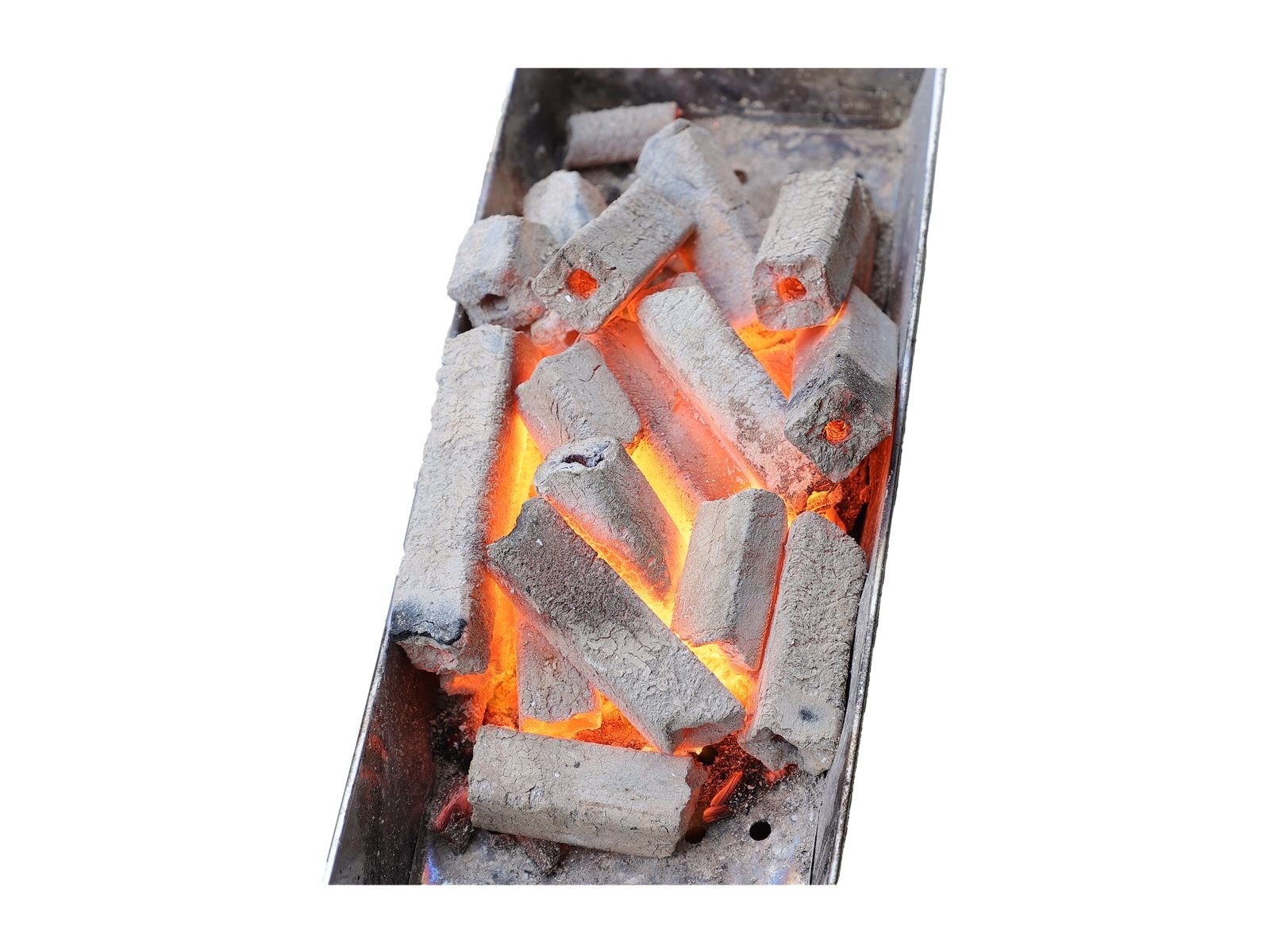
VUTRUX produces ogatan in two profiles from the same raw material and the same carbonization process. The hexagon type is a six-sided log with a hollow core running the full length of the piece. The square type is a solid, four-sided bar with no channel. Because the chemistry is nearly identical, the difference you feel on the grill comes almost entirely from geometry, and geometry controls how air moves through the fuel bed, how quickly the bed reaches cooking temperature, and how long a single load lasts before it needs topping up. For a broader view of pressed formats and packing, see our guide to ogatan charcoal briquettes for wholesale buyers.
Hexagon vs Square Ogatan: How the Two Profiles Burn
The defining feature of hexagon ogatan is that hollow center. The channel behaves like a small chimney: air is drawn up through the core, oxygen reaches the inside of the log rather than only its surface, and the charcoal climbs to full temperature faster and more evenly. Hexagon logs also stack into a natural lattice, leaving gaps between pieces that keep air moving across the entire bed. In day-to-day service this translates into quicker startup, a strong and responsive heat, and easy adjustment when a cook needs to push or pull temperature.
Square ogatan has no core. It is a solid mass, so it carries more carbon per piece and gives up that energy more slowly across a longer window. It takes a little longer to reach temperature, but once established it delivers a long, level burn that is ideal when you want to load a grill once and cook steadily for hours. So when buyers weigh the hexagon vs square ogatan decision, they are really choosing between fast, breathable heat and slow, dense endurance, two genuinely different tools rather than a better and a worse product.
Behöver du denna kvalitet per container?
Berätta om din marknad, volym och målspecifikation — vi svarar inom en arbetsdag med en offert och ett proverbjudande.
Airflow, Burn Time and Heat Output
The table below summarizes how the two profiles typically behave. Exact numbers shift with grill design, ventilation and how heavily you load the bed, but the direction of each difference stays consistent.
| Attribute | Hexagon ogatan | Square ogatan |
|---|---|---|
| Cross-section | Six-sided, hollow core | Four-sided, solid |
| Airflow | High, core acts as a chimney | Moderate, relies on gaps between bars |
| Time to cooking heat | Faster | Slower |
| Burn duration per load | Long | Longest |
| Heat profile | Strong and responsive | Steady and sustained |
| Best control style | Adjust quickly | Set and hold |
| Approx. MOQ per 20ft | ~15 MT | ~16 MT |
Because the square profile packs more mass into the same footprint, a 20ft container holds roughly 16 MT of square ogatan against about 15 MT of hexagon. That extra density is also why square burns longest per piece, while the hexagon core is what makes it light and recover so quickly. This is the heart of the hexagon vs square ogatan trade-off: if your priority is throughput and fast turnaround between orders, hexagon usually wins; if it is quiet, unattended endurance, square has the edge.
Which Profile for Which Use
Neither shape is better in the abstract; the right choice depends on how your kitchen actually runs.
- Yakitori, robata and skewer grills: hexagon ogatan. Its fast, breathable heat mirrors the feel of white charcoal and gives cooks the responsiveness they expect over a narrow grill.
- Busy a la carte lines: hexagon, for quick startup and confident heat control through a long service.
- Banquets, slow roasting and long braises: square ogatan, so a single load carries hours of cooking without a relight.
- Retail and consumer packs: square is forgiving for home users who want a long, low-maintenance burn, while hexagon appeals to enthusiasts chasing restaurant-style heat.
Many professional kitchens simply keep both and switch by station. If you are comparing fuels more broadly, our overview of binchotan, lump and briquettes places ogatan in context, and our guide to the best charcoal for restaurants matches fuels to service styles. Matching the profile to the station, rather than buying one shape for everything, is the simplest way to lower fuel cost without changing how you cook.
Sourcing, MOQ and Quality Checks
Oavsett vilken profil du väljer är det konsekvensen som skyddar både din mat och dina marginaler. Be vilken leverantör som helst om ett nyligen utfärdat analyscertifikat (COA) och bekräfta grunderna: bundet kol på runt 94 %, aska nära 3 %, fukt nära 3 % och svavel i princip noll, med ett värmevärde nära 8 300 kcal/kg. VUTRUX skickar varje parti med ett oberoende Vinacontrol COA och ett säkerhetsdatablad (MSDS), och kan tillhandahålla EUDR-tillräcklighetsbedömning och växtskyddsdokumentation för reglerade marknader. Oberoende självvärmningstester drar slutsatsen att produkten inte är IMDG Klass 4.2, även om vissa transportörer fortfarande bokar träkol under UN 1361.
Förpackning och förvaring skyddar den kvaliteten under transporten. Ogatan packas vanligtvis i kraftiga kartonger och bör förvaras torrt, eftersom träkol lätt återabsorberar fukt från fuktig luft, vilket saktar ner tändningen och sänker den effektiva värmen. Vid ankomsten bör du stickprovskontrollera några bitar för hårdhet och en ren, metallisk klang vid knackning, samt jämföra fukten med siffran på COA:t. En leverantör som packar noggrant och dokumenterar varje parti är en som du kan beställa ifrån igen med förtroende.
Standardvillkoren är FOB Hai Phong, med CIF och DDP tillgängligt, och betalning via T/T eller L/C. Som en planeringstjänst rymmer en 20-fotscontainer ungefär 15 ton sexkantig eller 16 ton fyrkantig ogatan. Vi rekommenderar alltid att du testar ett prov på din egen utrustning innan du binder dig till en hel container. När du är redo, begär en offert eller ett prov och berätta om din grilltyp och drifttimmar så att vi kan rekommendera rätt profil, storlek och packning.
Vanliga frågor
Är sexkantig eller fyrkantig ogatan bättre för yakitori?
Sexkantig ogatan passar oftast bäst för yakitori och robata. Dess ihåliga kärna drar luft genom biten, så den når temperatur snabbt och reagerar snabbt när kockarna behöver mer eller mindre värme över en smal grill. Fyrkantig ogatan fungerar också, men dess styrka är lång, obevakad uthållighet snarare än snabb respons.
Innehåller ogatan bindemedel eller kemikalier?
Kvalitetsogatan gör inte det. VUTRUX ogatan är tillverkad av komprimerad lövträspån som kolsyras under värme och tryck, utan koldamm, petroleumbindemedel eller påskyndare. Det är därför den brinner rent med väldigt lite rök eller lukt och har ett bundet kol på omkring 94 %.
Hur länge brinner ogatan jämfört med vanligt träkol?
Båda profilerna av ogatan brinner generellt längre än de flesta naturliga träkolsklumpar eftersom de är tätare och mer enhetliga. Fyrkantig ogatan räcker längst per påfyllning, medan den sexkantiga erbjuder en stark förbränning med snabbare uppstart. Den faktiska brinntiden beror på grillens luftflöde och hur hårt du fyller bädden.
Vad är minimibestämmelsen för ogatan?
Som riktlinje rymmer en 20-fotscontainer ungefär 15 ton sexkantig ogatan eller ungefär 16 ton fyrkantig ogatan. VUTRUX skeppar FOB Hai Phong med CIF- och DDP-alternativ och rekommenderar ett prov före din första helhetsbeställning. Kontakta oss med din målmarknad för exakt packning och villkor.