Germany is the biggest barbecue market in Europe, so the right charcoal supplier for Germany has to combine volume, unbroken consistency and airtight paperwork. Importers here serve everything from discounter and DIY-store shelves during the Grillsaison to a fast-growing wave of binchotan-fired steakhouses and yakitori bars in Berlin, Hamburg and Munich. This guide covers the grades that sell, the DIN EN 1860-2 and EUDR rules you will meet, and realistic lead times from Vietnam.
Key takeaways
- A dependable charcoal supplier for Germany is judged on batch-to-batch consistency and complete documentation, not headline price alone.
- German retail favours briquettes and hardwood lump; restaurants increasingly want fruitwood binchotan for clean, long, smokeless heat.
- Retail-bound charcoal is usually expected to meet DIN EN 1860-2, and consumer packaging must comply with the German Packaging Act (VerpackG).
- Budget for EUDR due diligence, a phytosanitary certificate and EUR.1 origin, plus roughly 30 to 45 days sea transit to Hamburg or Bremerhaven.
Choosing a charcoal supplier for the German market
For German importers, the cheapest quotation rarely wins in the long run. A dependable charcoal supplier for Germany is the one whose every container clears customs cleanly, matches the approved specification lot after lot, and lands when the Grillsaison demand curve says it should. Price matters, but German retail buyers and chefs are unusually exacting about consistency, safety and labeling.
Before you commit to any factory, confirm it can supply the following as standard:
- Per-lot, independent-lab COA (VUTRUX uses Vinacontrol) showing fixed carbon, ash, moisture and volatile matter, not a generic sheet.
- Full EU compliance data: EUDR traceability, a phytosanitary certificate and correct proof of origin.
- Samples before any container, so shelf or service quality is verified in advance.
- Clear Incoterms and payment terms: FOB Hai Phong, CIF or DDP, on T/T or L/C.
VUTRUX ships premium binchotan, Ogatan and hardwood lump FOB Hai Phong to more than 40 markets, so the export mechanics German buyers rely on are already proven. If the Vietnam route is new to you, our guide on how to import charcoal from Vietnam walks through it end to end, from fumigation and pallet treatment to booking the vessel.
Which charcoal grades sell in Germany
German demand splits cleanly between high-volume retail and a premium restaurant tier, and matching grade to channel is the fastest way to keep stock turning rather than sitting in a warehouse.
| Grade | Where it sells | Why German buyers choose it |
|---|---|---|
| Ogatan briquettes (hexagon and square) | Baumarkt, discounters, supermarkets | Long, steady burn and low ash for consumer Grillbriketts |
| Hardwood lump | Premium retail, grill houses | Fast lighting and natural flavour for enthusiast grillers |
| Fruitwood binchotan (eucalyptus, lychee, longan) | Steakhouses, yakitori and robata bars | Very high, smokeless, controllable heat for open kitchens |
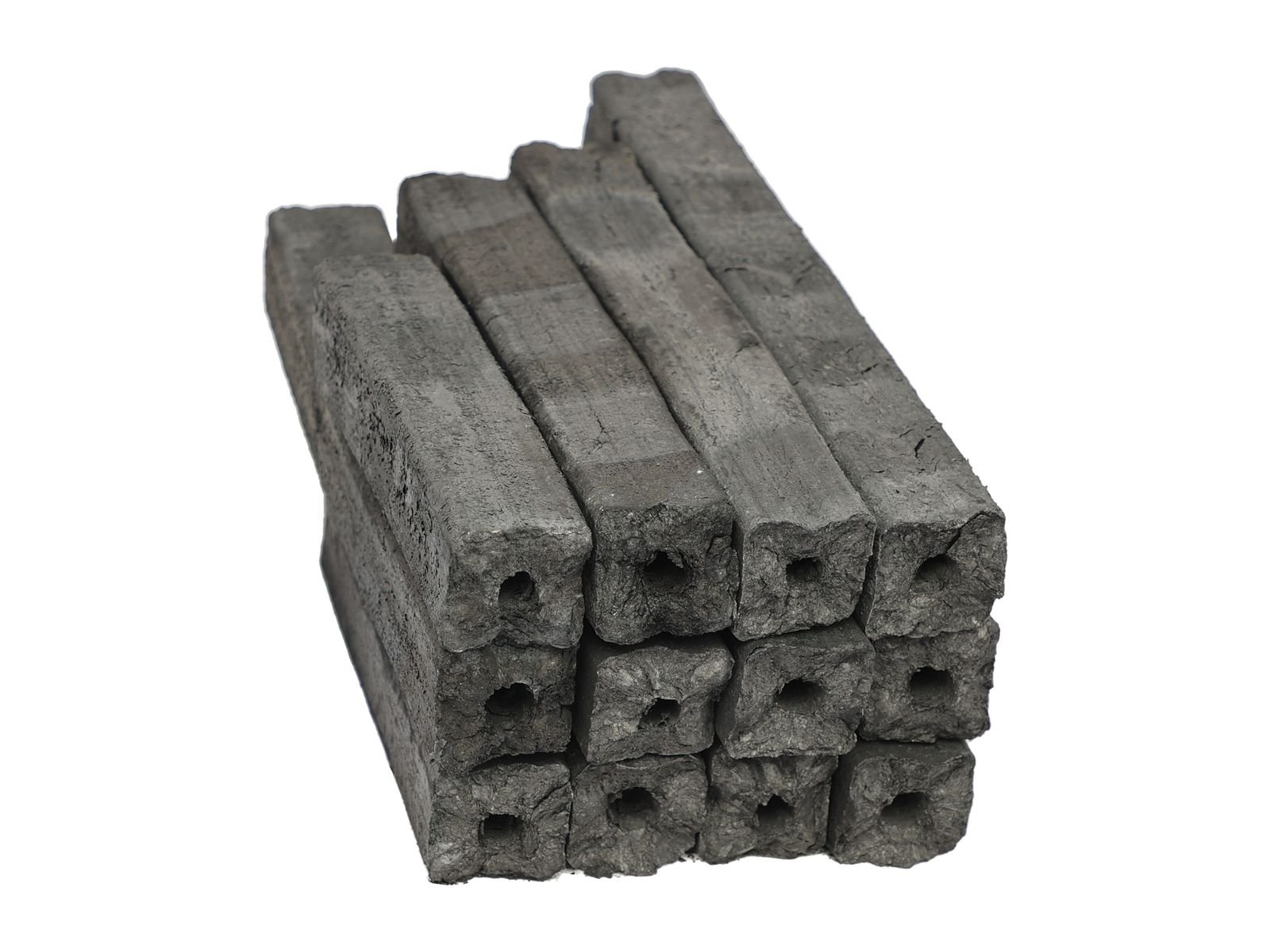
Retail volume in Germany still runs through briquettes and lump sold via DIY chains, discounters and supermarkets during the April-to-September Grillsaison. Here buyers want predictable burn time, low ash and clean German-language packaging. For that channel, VUTRUX Ogatan briquettes, hexagon with a hollow core for airflow or solid square for density, deliver the steady, long burn consumers associate with a quality Grillbrikett.
At the top end, the binchotan story is growing quickly. City steakhouses, yakitori counters and robata grills value white charcoal for heat that is intense yet controllable and almost smokeless, which suits open and semi-open kitchens. VUTRUX fruitwood binchotan carries fixed carbon typically around 95 percent with ash near 3 percent, giving chefs a long, clean burn that reduces refuelling mid-service.
Need this grade by the container?
Tell us your market, volume and target spec — we reply within one business day with a quote and a sample offer.
DIN EN 1860-2 and the quality German retailers expect
Charcoal sold to German consumers is generally expected to conform to DIN EN 1860-2, the German adoption of the European standard for barbecue charcoal and briquettes. Rather than a single figure, it sets minimum fixed-carbon and maximum moisture and foreign-matter limits, and it prohibits the use of mineral coal, coke and similar additives in barbecue fuel. Buyers also watch for low polycyclic aromatic hydrocarbon (PAH) levels, since the product cooks food directly over the coals.
This is where a natural, high-carbon product has a clear advantage. VUTRUX charcoal is carbonised hardwood and fruitwood with no coal or coke fillers, and lab-verified fixed carbon typically around 94 to 95 percent with ash near 3 percent sits comfortably inside the thresholds retailers ask about. A per-lot COA lets your QA team and your retail customer's buyer confirm the figures for each shipment rather than trusting a brochure.
If your buyer's technical file requires it, we can align documentation to the parameters they test against, and provide a sample COA before you order so nothing is left to assumption. Clarify early whether your customer wants conformity stated explicitly against DIN EN 1860-2, because that decision shapes both testing and the copy that appears on the bag.
Compliance and packaging: EUDR, phytosanitary and VerpackG
Documentation is where first-time German imports usually stumble. Get these right and clearance becomes routine.
| Requirement | What it covers | Who handles it |
|---|---|---|
| EUDR due-diligence statement | Deforestation-free, legal wood with harvest geolocation | Importer, using supplier traceability data |
| Phytosanitary certificate | Plant-based goods free of pests | Vietnamese plant-protection authority |
| EUR.1 or statement on origin | Preferential duty under the EU-Vietnam FTA | Issuing authority or REX-registered exporter |
| DIN EN 1860-2 conformity | Barbecue-charcoal quality for retail | Supplier spec plus lab COA |
| VerpackG registration | Packaging placed on the German market | Importer or first distributor |
The EU Deforestation Regulation (EUDR) now covers wood charcoal, so whoever first places the goods on the EU market must file a due-diligence statement with the geolocation of the harvest area and evidence of legal sourcing. Your supplier cannot file it for you, but it must provide the traceability data that makes it possible; our explainer on EUDR compliance for charcoal imports breaks the obligations down.
Germany adds a national layer through the Packaging Act (VerpackG). Importers who place packaged goods on the market normally must register in the LUCID packaging register and join a dual system, such as Der Gruene Punkt, for recycling. Consumer packaging also needs German-language labeling. Agree artwork, bag sizes and carton weights early, because private-label printing affects both cost and lead time.
Ports, lead times and how to order
Most VUTRUX shipments for Germany route to Hamburg or Bremerhaven, the country's main container gateways; some southern buyers clear via Rotterdam or Antwerp and move inland by rail or barge. Treat every stage below as a range and lock exact dates at booking.
| Stage | Typical duration |
|---|---|
| Sample dispatch and approval | A few days to about two weeks by courier |
| Production and consolidation | About two to four weeks by grade and volume |
| Ocean transit, Hai Phong to North Germany | Roughly 30 to 45 days, more with transshipment |
| Customs and EUDR checks on arrival | Build in a buffer |
Plan around full-container economics. A 20ft of binchotan runs about 9.6 metric tons net (960 ten-kilogram cartons), while Ogatan loads at roughly 15 tons for hexagon and 16 tons for square per 20ft. Independent self-heating tests conclude the charcoal is not IMDG Class 4.2, though some carriers still book it under UN 1361, so confirm the booking basis with your forwarder.
VUTRUX works on the terms German buyers expect: FOB Hai Phong, CIF or DDP, with payment by T/T or L/C, and a sample approved before any container ships. Ready to compare a firm offer against your current source? Request a quote with your target grade, volume and destination port, and we reply within one business day.
Frequently asked questions
What makes a good charcoal supplier for the German market?
Consistency and documentation come first. Look for a per-lot independent-lab COA, EUDR traceability, a phytosanitary certificate and correct origin proof, plus the ability to align product with DIN EN 1860-2 and to supply VerpackG-ready, German-language packaging. Always approve a sample before committing to a container.
Does barbecue charcoal sold in Germany have to meet DIN EN 1860-2?
Retail buyers generally expect conformity. DIN EN 1860-2 sets minimum fixed-carbon and maximum moisture and foreign-matter limits and prohibits mineral-coal and coke additives. A natural, high-carbon product with fixed carbon around 94 to 95 percent and ash near 3 percent fits comfortably, but confirm exactly what your customer requires.
Do I need to register under VerpackG to import charcoal into Germany?
If you place packaged goods on the German market, you normally must register in the LUCID packaging register and join a dual system for recycling, and your consumer packaging must carry German-language labeling. Rules depend on your role in the supply chain, so take local advice before your first shipment.
Which German ports does VUTRUX ship to?
We typically ship to Hamburg or Bremerhaven, Germany's main container gateways, with some southern buyers clearing via Rotterdam or Antwerp and moving inland by rail or barge. Allow roughly 30 to 45 days of sea transit from Hai Phong, plus a buffer for customs and EUDR checks.
What is the minimum order for German buyers?
We start with a sample so you can verify quality, then move to full-container loads for the best economics: about 9.6 metric tons of binchotan per 20ft, or roughly 15 to 16 tons of Ogatan. For a first order we can discuss trial quantities and shared-container options.