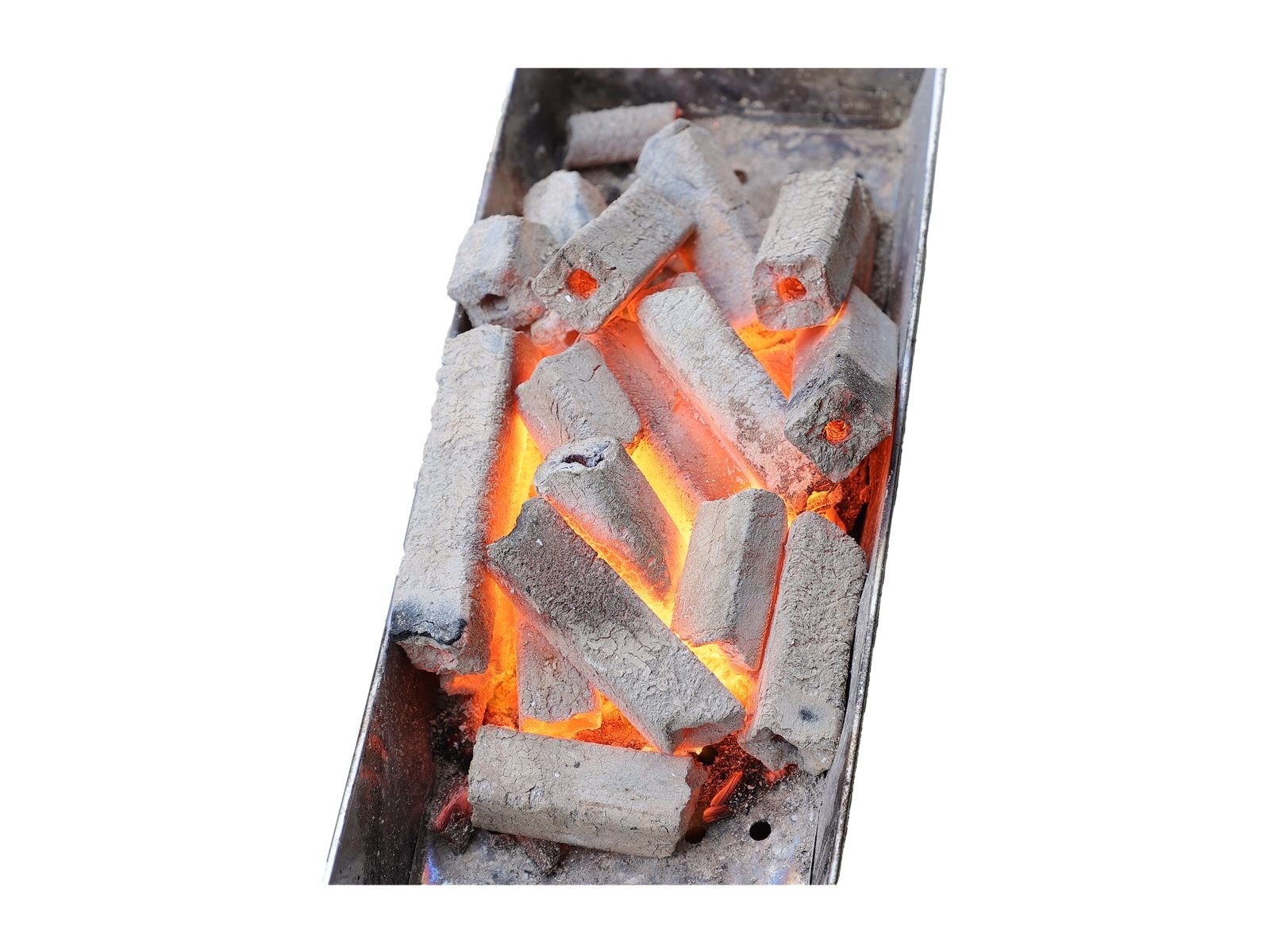
Ogatan is one of the most versatile charcoals VUTRUX exports, yet buyers often pause on a single detail before ordering: shape. This hexagon vs square ogatan comparison explains how the two profiles differ in airflow, density and burn time, and which one suits yakitori grills, busy a la carte lines or long banquet service. Get the geometry right and you cut relights, reduce waste and lower your real cost per cooking hour.
Key takeaways
- The hexagon vs square ogatan choice comes down to airflow versus density, not quality.
- Hexagon ogatan has a hollow core that acts as a chimney for faster, more responsive heat.
- Square ogatan is solid, denser and burns longest per load, ideal for long, unattended cooking.
- Both are binder-free, carry fixed carbon around 94%, and ship with an independent lab COA.
What Ogatan Is and Why Shape Matters
Ogatan is a machine-made charcoal produced from clean hardwood sawdust. The sawdust is compressed under high heat and pressure into a dense log, then carbonized in a kiln until it reaches a high, stable carbon content. Unlike many budget barbecue briquettes, quality ogatan contains no coal dust, no petroleum binders and no chemical accelerants; the natural lignin in the wood, released under pressure, is what holds each log together. The result is a hard, uniform fuel with fixed carbon typically around 94%, ash near 3%, moisture near 3% and effectively no sulphur, so it lights predictably and burns with very little smoke or odor. Because the raw material is sawdust, a byproduct of the timber and furniture industries, ogatan also makes efficient use of wood that would otherwise be wasted, which helps keep it competitively priced against natural lump.
VUTRUX produces ogatan in two profiles from the same raw material and the same carbonization process. The hexagon type is a six-sided log with a hollow core running the full length of the piece. The square type is a solid, four-sided bar with no channel. Because the chemistry is nearly identical, the difference you feel on the grill comes almost entirely from geometry, and geometry controls how air moves through the fuel bed, how quickly the bed reaches cooking temperature, and how long a single load lasts before it needs topping up. For a broader view of pressed formats and packing, see our guide to ogatan charcoal briquettes for wholesale buyers.
Hexagon vs Square Ogatan: How the Two Profiles Burn
The defining feature of hexagon ogatan is that hollow center. The channel behaves like a small chimney: air is drawn up through the core, oxygen reaches the inside of the log rather than only its surface, and the charcoal climbs to full temperature faster and more evenly. Hexagon logs also stack into a natural lattice, leaving gaps between pieces that keep air moving across the entire bed. In day-to-day service this translates into quicker startup, a strong and responsive heat, and easy adjustment when a cook needs to push or pull temperature.
Square ogatan has no core. It is a solid mass, so it carries more carbon per piece and gives up that energy more slowly across a longer window. It takes a little longer to reach temperature, but once established it delivers a long, level burn that is ideal when you want to load a grill once and cook steadily for hours. So when buyers weigh the hexagon vs square ogatan decision, they are really choosing between fast, breathable heat and slow, dense endurance, two genuinely different tools rather than a better and a worse product.
Need this grade by the container?
Tell us your market, volume and target spec — we reply within one business day with a quote and a sample offer.
Airflow, Burn Time and Heat Output
The table below summarizes how the two profiles typically behave. Exact numbers shift with grill design, ventilation and how heavily you load the bed, but the direction of each difference stays consistent.
| Attribute | Hexagon ogatan | Square ogatan |
|---|---|---|
| Cross-section | Six-sided, hollow core | Four-sided, solid |
| Airflow | High, core acts as a chimney | Moderate, relies on gaps between bars |
| Time to cooking heat | Faster | Slower |
| Burn duration per load | Long | Longest |
| Heat profile | Strong and responsive | Steady and sustained |
| Best control style | Adjust quickly | Set and hold |
| Approx. MOQ per 20ft | ~15 MT | ~16 MT |
Because the square profile packs more mass into the same footprint, a 20ft container holds roughly 16 MT of square ogatan against about 15 MT of hexagon. That extra density is also why square burns longest per piece, while the hexagon core is what makes it light and recover so quickly. This is the heart of the hexagon vs square ogatan trade-off: if your priority is throughput and fast turnaround between orders, hexagon usually wins; if it is quiet, unattended endurance, square has the edge.
Which Profile for Which Use
Neither shape is better in the abstract; the right choice depends on how your kitchen actually runs.
- Yakitori, robata and skewer grills: hexagon ogatan. Its fast, breathable heat mirrors the feel of white charcoal and gives cooks the responsiveness they expect over a narrow grill.
- Busy a la carte lines: hexagon, for quick startup and confident heat control through a long service.
- Banquets, slow roasting and long braises: square ogatan, so a single load carries hours of cooking without a relight.
- Retail and consumer packs: square is forgiving for home users who want a long, low-maintenance burn, while hexagon appeals to enthusiasts chasing restaurant-style heat.
Many professional kitchens simply keep both and switch by station. If you are comparing fuels more broadly, our overview of binchotan, lump and briquettes places ogatan in context, and our guide to the best charcoal for restaurants matches fuels to service styles. Matching the profile to the station, rather than buying one shape for everything, is the simplest way to lower fuel cost without changing how you cook.
Sourcing, MOQ and Quality Checks
Whichever profile you pick, consistency is what protects both your food and your margins. Ask any supplier for a recent Certificate of Analysis and confirm the fundamentals: fixed carbon around 94%, ash near 3%, moisture near 3% and sulphur effectively zero, with calorific value close to 8,300 kcal/kg. VUTRUX ships every lot with an independent Vinacontrol COA and an MSDS, and can supply EUDR due-diligence and phytosanitary documentation for regulated markets. Independent self-heating tests conclude the product is not IMDG Class 4.2, although some carriers still book charcoal under UN 1361.
Packaging and storage protect that quality in transit. Ogatan is typically packed in sturdy cartons and should be kept dry, because charcoal readily reabsorbs moisture from humid air, which slows ignition and lowers effective heat. On arrival, spot-check a few logs for hardness and a clean, metallic ring when tapped, and compare moisture against the figure on the COA. A supplier that packs carefully and documents each lot is one you can reorder from with confidence.
Standard terms are FOB Hai Phong, with CIF and DDP available, and payment by T/T or L/C. As a planning guide, a 20ft container holds roughly 15 MT of hexagon or 16 MT of square ogatan. We always recommend testing a sample on your own equipment before committing to a full container. When you are ready, request a quote or a sample and tell us your grill type and service hours so we can recommend the right profile, size and packing.
Frequently asked questions
Is hexagon or square ogatan better for yakitori?
Hexagon ogatan is usually the better fit for yakitori and robata. Its hollow core pulls air through the log, so it reaches temperature quickly and responds fast when cooks need more or less heat over a narrow grill. Square ogatan works too, but its strength is long, unattended endurance rather than quick response.
Does ogatan contain binders or chemicals?
Quality ogatan does not. VUTRUX ogatan is made from compressed hardwood sawdust that is carbonized under heat and pressure, with no coal dust, petroleum binders or accelerants. That is why it burns cleanly with very little smoke or odor and carries fixed carbon around 94%.
How long does ogatan burn compared with lump charcoal?
Both profiles of ogatan generally burn longer than most natural lump charcoal because they are denser and more uniform. Square ogatan lasts longest per load, while hexagon offers a strong burn with faster startup. Actual burn time depends on grill airflow and how heavily you load the bed.
What is the minimum order for ogatan?
As a guide, a 20ft container holds about 15 MT of hexagon ogatan or about 16 MT of square ogatan. VUTRUX ships FOB Hai Phong with CIF and DDP options and recommends a sample before your first full order. Contact us with your target market for exact packing and terms.