Few fuel decisions shape a grill kitchen's economics as directly as lump vs briquettes for restaurants. Both burn hot and both cook beautifully, yet their heat curves, consistency, spark and waste differ enough that the wrong pick quietly taxes your margins every shift. This guide compares hardwood lump charcoal and machine-made briquettes the way a buyer should: on performance at the pass and on true cost per service, not on the price of a single carton.
Key takeaways
- Lump charcoal lights fast and hits high peak heat, ideal for searing, but burns less evenly and produces more sparks and fines.
- Briquettes such as VUTRUX Ogatan burn longer at a steadier temperature with very low smoke and spark, which suits long service windows.
- Cost per service depends on burn time and waste, not the price per bag; a cheaper carton can cost more per cover.
- Many high-volume kitchens run both: lump for a fast sear station, briquettes for sustained grilling and holding.
Lump vs briquettes for restaurants: the real trade-off
Lump charcoal is simply hardwood that has been carbonised and left in its natural, irregular chunks. It keeps the character of the wood, lights quickly and reaches a fierce searing heat. VUTRUX hardwood lump and premium binchotan white charcoal both sit in this family, prized for clean combustion and high fixed carbon.
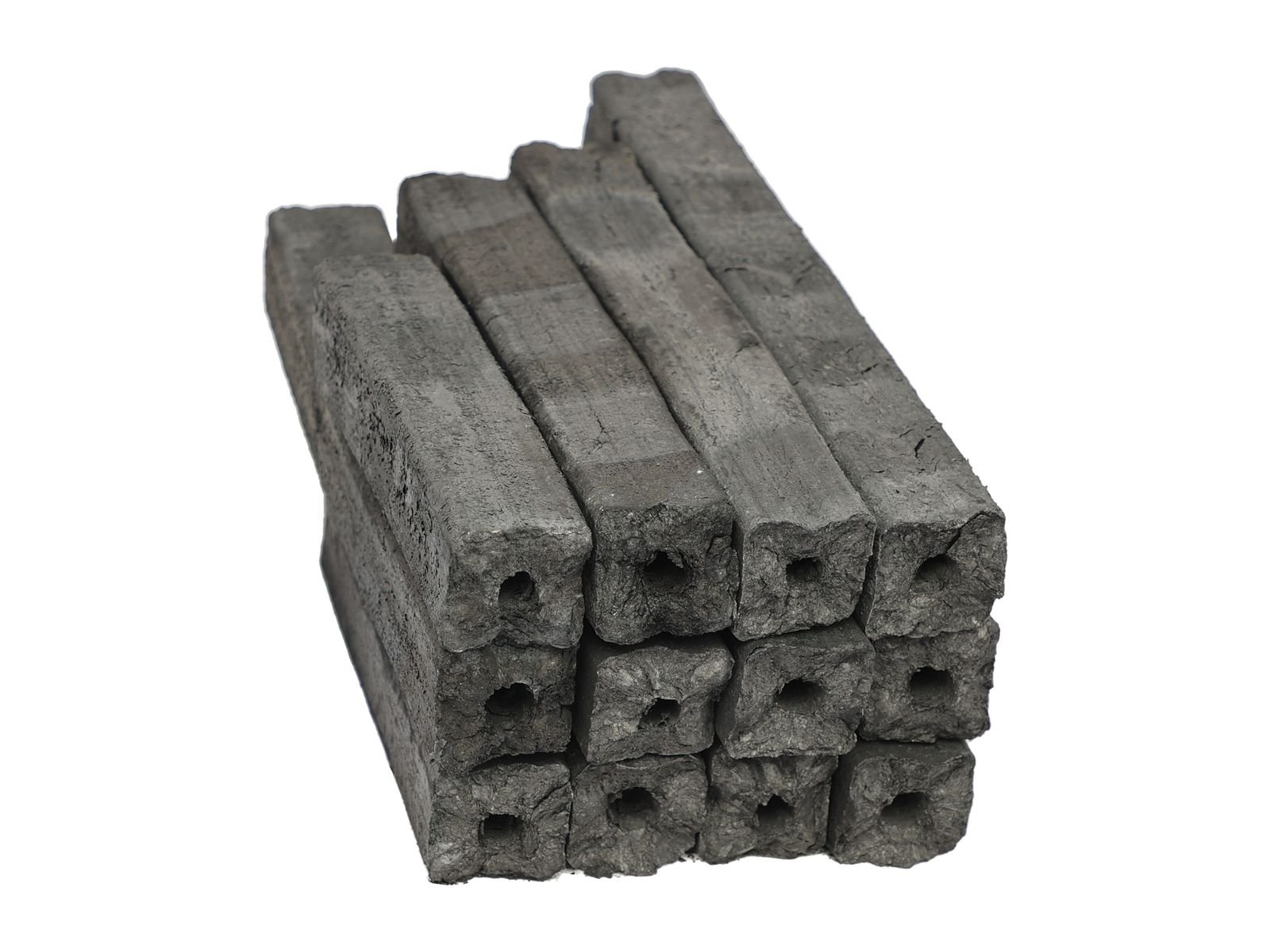
Briquettes are a manufactured fuel. VUTRUX Ogatan is machine-extruded from compressed hardwood sawdust into uniform hexagon (hollow core) and square (solid) logs, with no chemical binders or fillers. That engineering is the whole point: every piece shares the same size, density and moisture, so the burn is predictable. Budget supermarket briquettes can be a different story, often bulked out with binders and mineral additives, which is why specification matters. For a wider technical breakdown of all three families, see our guide to binchotan vs lump vs briquettes.
Heat output and temperature control
Lump wins on ignition and peak heat. It catches in roughly 15 to 20 minutes, throws intense radiant heat for a strong sear, and responds fast when you open the vents. The trade-off is a steeper decline: because pieces vary in size, the bed burns unevenly and cooler pockets appear as the session goes on.
Briquettes trade a little peak temperature for a long, flat plateau. Uniform logs pack a consistent bed, and the hollow core of Ogatan hexagon draws air through the centre so it burns evenly from the inside out. Independent testing puts VUTRUX charcoal at roughly 8,300 kcal/kg calorific value, with Ogatan fixed carbon around 94%, so there is plenty of energy on tap; it simply arrives as a steady output rather than a sharp spike. For most stations, controllable and repeatable beats dramatic.
Need this grade by the container?
Tell us your market, volume and target spec — we reply within one business day with a quote and a sample offer.
Consistency, burn time and throughput
On a busy line, consistency is money. Because briquettes are identical, a cook quickly learns exactly how many pieces a station needs and how long they last, so reloads are scheduled rather than reactive. Burn time is long, which means fewer interruptions during a three or four hour service and less charcoal handling under pressure.
Lump demands more attention. It burns faster, leaves more fine debris at the bottom of the carton, and the odd piece will spark or pop. Skilled grill cooks manage this happily, but it is labour. The table below summarises how the two behave where it counts.
| Attribute | Hardwood lump | Briquettes (Ogatan) |
|---|---|---|
| Ignition | Fast (15-20 min) | Moderate (20-30 min) |
| Peak heat | Very high, great for searing | High and sustained |
| Heat stability | Tapers, uneven bed | Long, flat plateau |
| Burn time | Shorter | Longer |
| Smoke | Low to moderate | Very low |
| Sparks and fines | More | Minimal |
| Ash | Moderate (about 3%) | Low (about 3%) |
| Piece consistency | Variable | Uniform |
| Best for | Fast sear stations | Sustained grilling and holding |
Cost per service, not cost per bag
The most expensive mistake in charcoal buying is comparing the price of a carton instead of the cost of a service. What you actually pay per cover depends on how much fuel burns per hour, how long it lasts, and how much ends up as unusable dust. A cheaper bag that burns out in half the time and sheds a fifth of its weight as fines is not cheaper at all.
In the lump vs briquettes calculation, briquettes usually win for long, steady grilling because their long burn cuts reloads and waste, while lump can win where you need short, intense bursts and relight often. The only reliable answer is to measure it in your own kitchen: run a sample over a real service, weigh what you use and what you waste, and divide by covers. Our overview of the best charcoal for restaurants walks through that calculation, and you can request a quote and a sample to test both formats on your own grill.
Matching charcoal to your menu and station
The best kitchens rarely choose one fuel for everything. Match the charcoal to the job:
- Yakitori, robata and premium grilling: binchotan white charcoal for clean, odourless, long, high heat.
- Steak and a la carte searing: hardwood lump for fast ignition and aggressive peak heat.
- High-volume BBQ and sustained service: Ogatan hexagon for a long, even, low-smoke bed.
- Holding and slow cooking: Ogatan square (solid) for maximum burn time.
VUTRUX Ogatan ships at roughly 15 MT (hexagon) to 16 MT (square) per 20ft container, while binchotan runs about 9.6 MT net per 20ft in 10 kg cartons, which helps you plan a mixed order around real service volumes.
Sourcing lump and briquettes for a professional kitchen
Whichever format you choose, buy on specification, not promises. Ask any exporter for a per-lot Certificate of Analysis, an MSDS, and honest sizing and packaging details. VUTRUX charcoal typically shows fixed carbon around 94 to 95%, ash near 3%, moisture near 3% and effectively zero sulphur, with EUDR due-diligence and phytosanitary documentation ready and Vinacontrol self-heating tests concluding the product is not IMDG Class 4.2 (though carriers may still book it as UN 1361).
Consistent 10 kg cartons, FOB Hai Phong terms and a sample before every order let you standardise your grill station across sites. When you are ready to compare formats head to head, request a sample and quote and specify the grades and sizes your menu needs.
Frequently asked questions
Are lump or briquettes better for a restaurant grill?
Neither is universally better. In the lump vs briquettes decision for a restaurant grill, it depends on your service: lump gives fast, intense heat for searing but burns down quicker and less evenly, while briquettes like Ogatan burn longer and steadier with very low smoke, which suits long service windows. Many kitchens run both and match the fuel to each station.
Do charcoal briquettes contain chemicals or binders?
Some budget supermarket briquettes do, using starch or mineral binders and accelerants. VUTRUX Ogatan is different: it is extruded from compressed hardwood sawdust with no chemical binders, so it burns clean with very low smoke and almost no odour. Always ask for a Certificate of Analysis to confirm what you are buying.
How much charcoal does a restaurant use per service?
It varies widely with grill size, station count and cover volume, so there is no single figure. The practical approach is to run a sample over a real service, weigh what you burn and what you waste, and calculate cost per cover. That number, not the price per carton, is what should drive your decision.
What is the minimum order for restaurant charcoal from VUTRUX?
As an export supplier, VUTRUX ships by the container. As a guide, Ogatan runs about 15 MT (hexagon) to 16 MT (square) per 20ft, and binchotan about 9.6 MT net per 20ft in 10 kg cartons. Distributors often consolidate orders for restaurant clients, so request a quote to discuss volumes and terms.