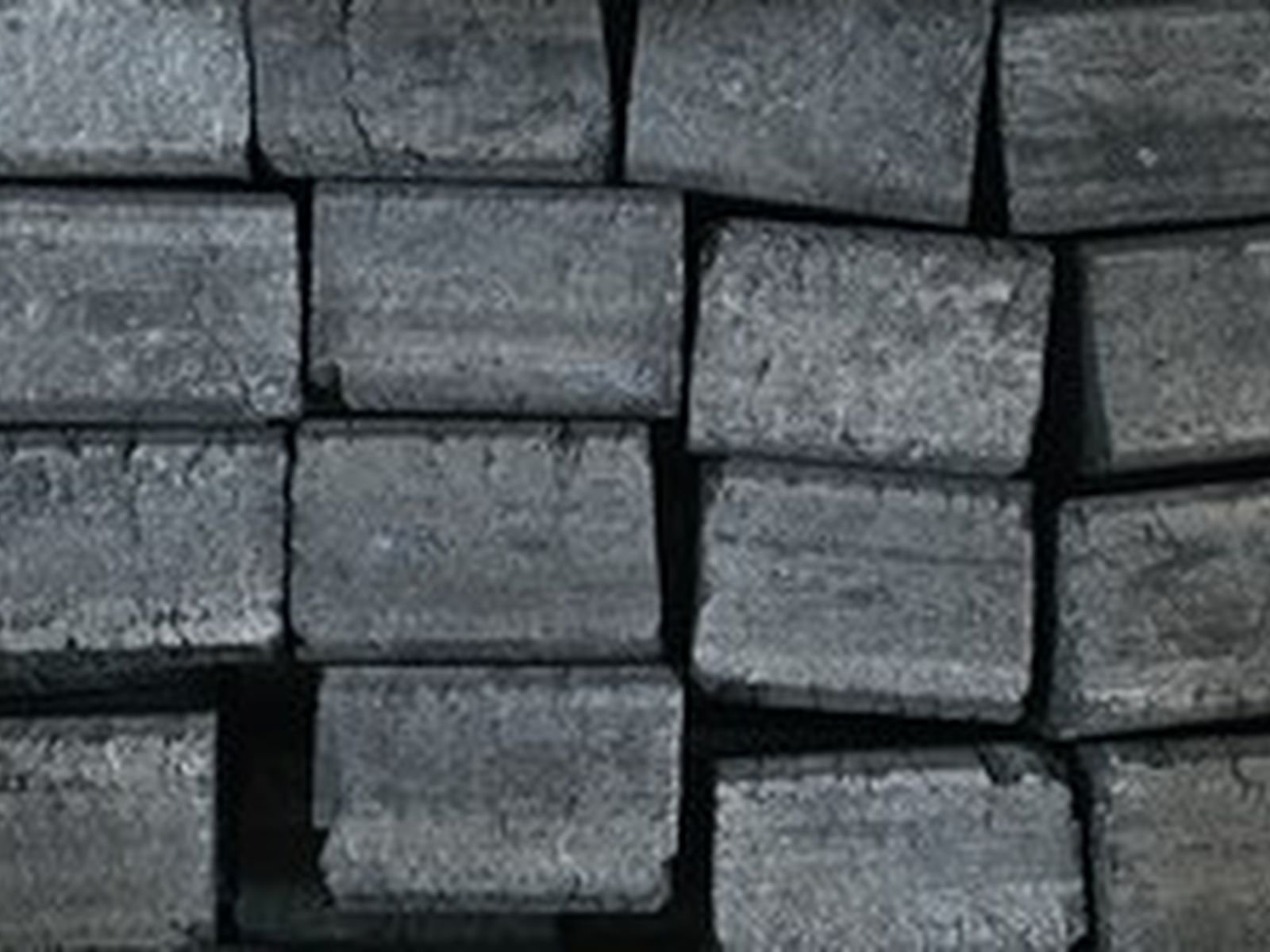
Understanding how charcoal is made explains almost everything about how a fuel will perform: how hot it burns, how long it lasts, how much smoke or spark it throws, and how cleanly it finishes. Charcoal is not simply burnt wood. It is wood that has been cooked in a low-oxygen kiln until almost everything except carbon has been driven off, a transformation called carbonization or pyrolysis. The species of wood, the kiln design, the peak temperature and the cooling method together decide whether the result is premium binchotan, dependable ogatan or ordinary black lump charcoal.
Key takeaways
- Charcoal is produced by carbonization: heating wood in a low-oxygen kiln so water and volatile compounds leave and mostly fixed carbon remains.
- Peak temperature and cooling method are what separate white charcoal (binchotan) from ordinary black charcoal.
- Ogatan is made by compressing hardwood sawdust into logs and then carbonizing them, giving a uniform, low-spark fuel.
- Denser hardwoods yield harder, longer-burning charcoal, so species selection matters as much as the kiln.
- A per-lot certificate of analysis is the practical proof that the process delivered high fixed carbon and low ash.
What carbonization actually means
At its simplest, carbonization is controlled cooking. Fresh wood is roughly half water and, once dried, still contains a large fraction of volatile organic compounds such as resins, sugars and tars. When wood is heated to around 400 to 700 degrees Celsius with the air supply restricted, it cannot burn to ash. Instead it breaks down: moisture evaporates first, then the volatiles are driven off as smoke and gas, leaving behind a rigid lattice of almost pure carbon.
This is why good charcoal weighs so little for its size, and why it lights and burns so differently from a raw log. A finished lump is mostly fixed carbon, the part that glows and releases heat without flame or smoke. Volatile matter that is left behind is what causes spitting, acrid smoke and off-flavours, so a well-carbonized charcoal is defined as much by what is absent as by what remains. The more completely the volatiles are removed, the cleaner the burn. Independent testing of VUTRUX charcoal by Vinacontrol typically shows fixed carbon around 95% for binchotan and around 94% for ogatan, with ash near 3% and moisture near 3%.
How charcoal is made, step by step
Although kilns vary from traditional earthen mounds to modern brick and steel designs, the sequence of how charcoal is made stays remarkably consistent from one workshop to the next:
- Species selection and seasoning. Logs are sorted by species and left to lose moisture. Denser hardwoods and fruitwoods are chosen for premium grades.
- Loading the kiln. Wood is stacked to allow even heat flow while keeping oxygen low enough to prevent open burning.
- Drying phase. Gentle heat drives off remaining water; rushing this step causes cracking and weak, dusty charcoal.
- Carbonization. The temperature climbs and the volatiles leave as smoke. The colour of the exhaust, shifting from white steam to a thin blue haze, tells an experienced operator how far the process has gone.
- Refining or finishing. For white charcoal the pieces are briefly raised to a very high temperature; for black charcoal the kiln is simply sealed.
- Cooling. The charcoal is cooled and stabilised before sorting, sizing and packing.
Each phase can take hours or days depending on the kiln, and skipping steps to save time is the single most common cause of poor, fragile charcoal that arrives as fines and dust. To see how these production choices show up in the finished product, read our guide on natural versus industrial charcoal.
Need this grade by the container?
Tell us your market, volume and target spec — we reply within one business day with a quote and a sample offer.
White charcoal versus black charcoal
The most important fork in how charcoal is made is the way the kiln is finished. Black charcoal is produced by sealing the kiln at the end of carbonization and letting the charcoal cool slowly inside. It lights easily, burns hot and is common for everyday grilling.
White charcoal, known in Japanese as binchotan, takes the opposite approach. Near the end, the glowing pieces are raked out of the kiln at a very high temperature and quickly smothered with a damp mixture of earth and ash. This rapid finishing hardens the surface and pushes fixed carbon even higher. The result is a dense, almost metallic charcoal that rings like china when two pieces are tapped together, burns for hours at a steady temperature and produces very little smoke or flavour of its own. That metallic ring is the classic field test buyers use to recognise genuine, fully finished binchotan. If you are new to the category, our explainer on what binchotan white charcoal is covers its history and uses in detail.
VUTRUX produces binchotan from dense hardwoods and fruitwoods including eucalyptus, lychee, longan and orange-pomelo, in grades A and B, round or split, in sizes from roughly 80 to 200 millimetres, packed in 10 kilogram cartons.
How ogatan is made from sawdust
Not all charcoal starts as whole logs. Ogatan is a machine-made charcoal produced from clean hardwood sawdust, a by-product of the timber industry. The process adds two steps at the front before the familiar carbonization stage:
- Extrusion. Dried sawdust is compressed under high pressure and heat into a dense log, usually with a hollow hexagonal core or a solid square profile. No chemical binder is needed; the wood's own lignin softens and holds the shape together.
- Carbonization. These raw pressed logs are then carbonized in a kiln much like solid wood, yielding a hard, uniform charcoal with a clean fracture.
Because it is engineered rather than harvested piece by piece, ogatan is exceptionally consistent in size, density and burn time, with very little spark and long, even heat. The hollow hexagon lights and breathes a little faster, while the solid square packs more mass for the longest burns, which is why both are popular for restaurants and long service periods. You can read more in our ogatan charcoal wholesale guide. VUTRUX supplies both hexagonal (hollow core) and square (solid) ogatan.
Why the method decides quality
Two lumps of charcoal can look almost identical and behave completely differently, and the reason almost always traces back to how they were made. The variables that matter most are summarised below:
| Process factor | Effect on the finished charcoal |
|---|---|
| Wood density and species | Harder, denser wood yields harder charcoal that burns longer and breaks less in transit. |
| Drying discipline | Proper drying prevents cracks and reduces fines and dust. |
| Peak temperature | Higher finishing temperatures raise fixed carbon and lower smoke. |
| Cooling method | Slow sealed cooling gives black charcoal; rapid smothering gives white charcoal. |
Understanding how charcoal is made is therefore the fastest way to predict how a fuel will behave in a grill or an oven, long before you light it. It is also why a serious exporter treats each production lot as measurable rather than assumed. VUTRUX provides a per-lot certificate of analysis, so buyers can verify fixed carbon, ash, moisture and calorific value rather than take them on trust. Calorific value typically lands near 8,300 kilocalories per kilogram, and near-zero sulphur means the fuel stays close to odourless.
How VUTRUX controls the process
Controlling quality means controlling every stage above, not just the final inspection. In practice that involves selecting the right hardwood and fruitwood species, working with kiln partners who dry and finish patiently, and grading the output by size and density before packing into standard 10 kilogram cartons. This end-to-end oversight is what separates a trading intermediary from a producer who can genuinely stand behind the charcoal it ships.
It also means documentation that travels with the goods: a certificate of analysis for each lot, a material safety data sheet, phytosanitary certification and EUDR due-diligence readiness. Independent self-heating tests conclude the charcoal is not IMDG Class 4.2, although carriers may still book it under UN 1361. Serving more than 40 export markets on FOB, CIF or DDP terms, VUTRUX ships from Hai Phong with samples available before any order. To match a grade to your equipment and volume, request a quote or a sample and our team will recommend the right specification.
Frequently asked questions
What is the difference between charcoal and firewood?
Firewood is raw wood that still contains water and volatile compounds, so it produces flame, smoke and ash as it burns. Charcoal has already been carbonized, meaning those volatiles were driven off in a kiln. What remains is mostly fixed carbon, which glows at high heat with little smoke and burns far longer than an equivalent piece of wood.
What temperature is needed to make charcoal?
Carbonization generally happens between about 400 and 700 degrees Celsius in a low-oxygen kiln. Ordinary black charcoal is finished at the lower end, while white charcoal such as binchotan is briefly raised to a much higher temperature before being smothered and cooled, which is what gives it its density and clean, long burn.
Is charcoal made with chemicals?
Pure lump and white charcoal are made from wood alone, with no binder or accelerant. Ogatan is compressed from hardwood sawdust and held together by the wood's natural lignin, again without chemical binders. This is different from some retail instant-light briquettes, which can contain fillers and ignition additives.
How long does it take to make charcoal?
It depends on the kiln and the product. Traditional white-charcoal cycles can run for many days, because the drying, carbonization and high-temperature finishing stages are all done slowly to protect quality. Rushing the process is the most common cause of brittle, dusty charcoal, so reputable producers prioritise consistency over speed.