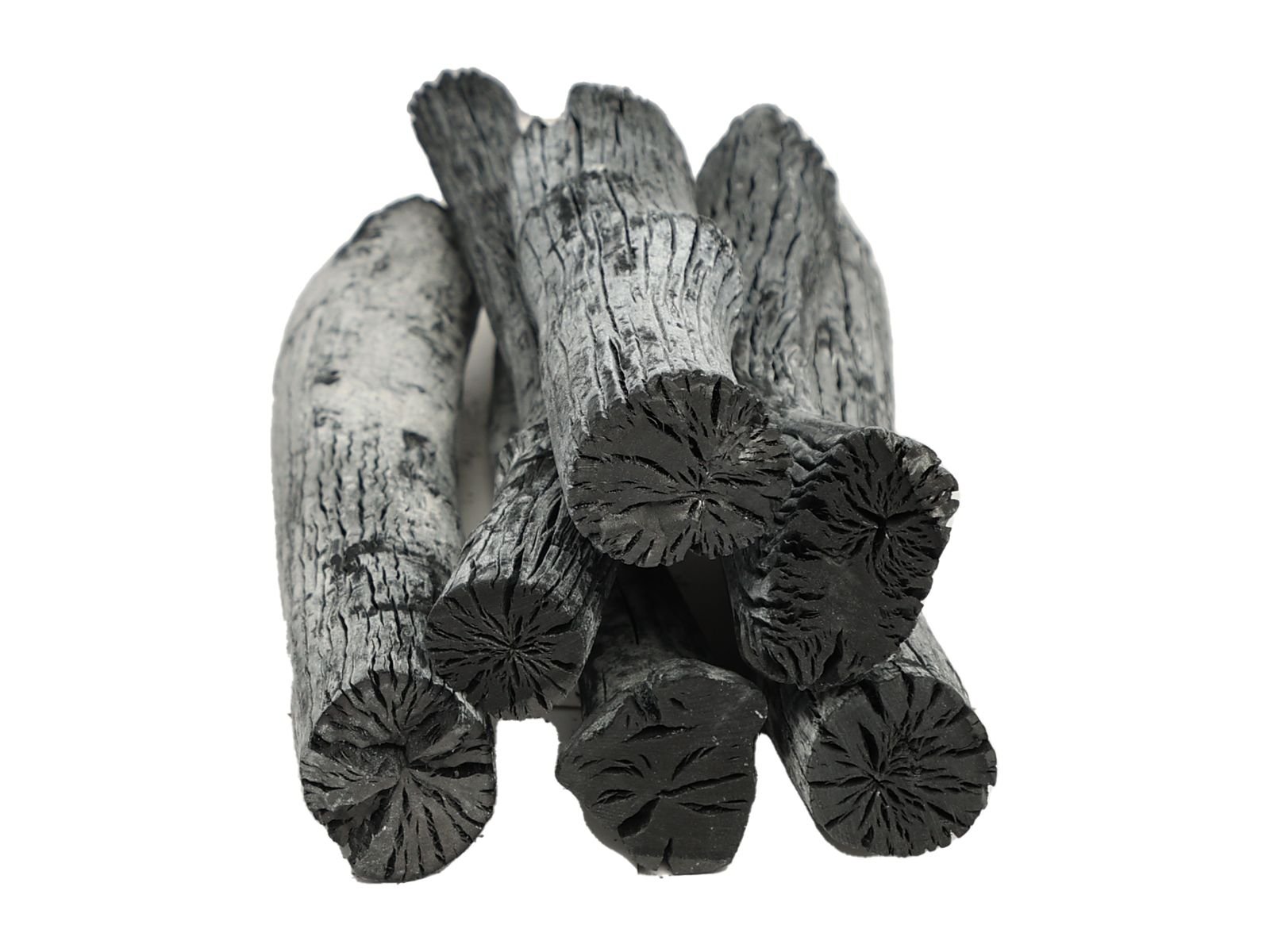
Ask any yakitori chef why binchotan burns clean and you hear the same answer: no smoke, no sparks, no off-flavors, just steady radiant heat that lasts for hours. That performance is not luck or marketing. It is the predictable result of dense raw wood, an extreme carbonization process and a chemistry that leaves behind almost nothing but carbon. This guide explains the science behind white charcoal - what a clean burn really is, and why VUTRUX binchotan runs hot, long and remarkably clean.
Key takeaways
- Binchotan burns clean because it is almost pure carbon - high-temperature firing drives off the volatile compounds that cause smoke, soot and odor.
- Dense fruitwood and hardwood pack more carbon into each piece, so binchotan burns hotter and far longer than ordinary lump of the same size.
- Low volatile matter and near-zero sulphur mean no flare-ups and no chemical taint, which is why binchotan is the fuel of choice for delicate grilling.
- On independent Vinacontrol testing, VUTRUX binchotan typically shows around 95% fixed carbon with ash and moisture near 3%.
- Clean and smokeless is not the same as risk-free; always burn charcoal with proper ventilation, because it still produces carbon monoxide.
What a clean burn actually means
Before we explain why binchotan burns clean, it helps to define what a clean burn is. When cooks say a charcoal is clean, they usually mean four things at once.
- Little or no visible smoke once the coal is lit and glowing.
- No sparking or spitting that throws embers across the grill.
- No acrid odor or chemical taint passed on to the food.
- Very little ash and residue left in the grill afterwards.
Ordinary charcoal and cheap briquettes fail on one or more of these points. They smoke as trapped moisture and volatile compounds cook off, they spit as pockets of gas escape, and filler-heavy briquettes can carry a faint chemical smell. Binchotan, the traditional Japanese white charcoal, is engineered by its process to avoid all four problems at once. The result is a fuel that behaves less like burning wood and more like a glowing radiant element: it produces heat you can feel from a distance, but almost none of the visible drama of an ordinary fire. To understand what sets it apart, it helps to look at what it is made from and how it is made.
It starts with dense fruitwood
A clean, long burn begins with the raw material, long before any kiln is lit. Binchotan is made from dense hardwoods and fruitwoods, and density is the single physical property that matters most. Denser wood packs more carbon into the same volume, so a finished piece holds more fuel and burns longer and hotter before it is spent.
VUTRUX makes binchotan from tight-grained species chosen for exactly this reason: eucalyptus (bach dan), lychee and longan (vai and nhan), and orange-pomelo 'mai tieu' (cam buoi). These woods are hard, heavy and low in resin, which keeps the burn steady and the smoke low. Lychee in particular is prized for an exceptionally even, long-lasting heat. You can feel the difference in the finished product: true binchotan is surprisingly heavy for its size and rings almost like ceramic when two pieces are tapped together. Lighter, softer woods simply cannot carbonize into the same dense, glassy coal, which is why cheap charcoal made from mixed offcuts smokes more and fades faster. For more on how each wood behaves, see what binchotan white charcoal is.
Need this grade by the container?
Tell us your market, volume and target spec — we reply within one business day with a quote and a sample offer.
Why binchotan burns clean: the carbonization science
The heart of the answer to why binchotan burns clean is how it is made. White charcoal is produced in a two-stage process that is far more extreme than the smoldering earth pits used for ordinary black charcoal.
First the wood is carbonized slowly at moderate heat to drive out water and begin breaking down its structure. Then, in the defining step, the kiln temperature is pushed very high - often around 1,000 degrees Celsius - and the glowing charcoal is raked out and quickly smothered in a damp mix of earth, sand and ash. This does two things. The intense heat drives off almost every volatile compound in the wood, the tars, resins and light gases that would otherwise burn as smoke and soot. And the rapid cooling under the powder leaves the pale, mineral-dust surface that gives white charcoal its name.
What remains is a coal that is almost pure fixed carbon. Because the volatile matter has already been cooked away in the kiln, there is very little left to smoke, flare or smell when you light the charcoal later. In effect, the messy, smoky part of combustion has been done for you at the point of manufacture. This is the fundamental reason binchotan lights quietly, burns with a clear shimmer of heat rather than dancing flames, and gives off almost no smoke in service.
Ordinary charcoal still contains volatile compounds that burn off as smoke at the grill. Binchotan has already lost most of them in the kiln, which is why it burns so cleanly when you finally cook on it.
The numbers behind the clean burn
The clean-burn story is not just craft tradition; it shows up clearly in laboratory testing. On independent Vinacontrol analysis, VUTRUX binchotan typically reports around 95% fixed carbon, with ash and moisture near 3% and sulphur close to zero. High fixed carbon means more heat and a longer burn; low everything-else means less smoke, less residue and no chemical taint. The table below shows how each figure translates into behavior at the grill.
| Property | Typical VUTRUX binchotan | Why it drives a clean burn |
|---|---|---|
| Fixed carbon | Around 95% | More pure fuel, so hotter and longer heat |
| Volatile matter | Very low | Little left to smoke, flare or smell |
| Ash | Around 3% | Minimal residue and cleaner airflow |
| Moisture | Around 3% | Lights easily, with no hissing or steam |
| Sulphur | Near 0% | No sour odor or taint on food |
| Calorific value | Around 8,300 kcal/kg | High, steady energy output |
These are typical ranges from independent testing, not a guarantee for every single piece, which is exactly why a serious supplier issues a fresh certificate for each production lot rather than reusing one flattering result. If you want to interpret these figures yourself on any supplier's paperwork, our guide on how to read a charcoal COA explains what each number really tells you.
Hot, long and easy to control
Put the raw material, the process and the chemistry together and you get the burn profile that professional chefs prize. Hot: dense, high-carbon coal radiates fierce, even infrared heat that is ideal for searing steaks and for cooking delicate skewers alike. Long: because each piece is so dense and so nearly pure carbon, a bed of binchotan can hold cooking heat for several hours, far longer than ordinary lump of the same volume, which reduces how often the grill has to be refuelled during a busy service.
Controllable: binchotan responds to airflow rather than to flames. Give it more oxygen and it glows hotter; restrict the air and it settles down, all without the flare-ups that come from volatile-rich fuels reacting to dripping fat. It can also be extinguished, dried and relit the next day, which cuts fuel waste across a week of service. That combination of qualities is why it is the default fuel for yakitori, robata, sushi counters and high-end steak grilling. See how it performs in a professional kitchen in our guide to the best charcoal for restaurants.
Clean does not mean risk-free: burn it safely
One important caveat sits alongside all of this. A clean, smokeless burn is not the same as a safe-in-any-space burn. Like all charcoal, binchotan consumes oxygen and produces carbon monoxide, a colorless and odorless gas, as it burns. The very fact that binchotan gives off almost no smoke or smell can make it easy to forget that a fire is even lit, so proper ventilation is essential wherever it is used indoors, and it should never be burned in an unventilated room to heat a space.
Used correctly - in a well-ventilated kitchen or outdoors, with the right grade and size for the job - binchotan delivers the cleanest, most controllable charcoal heat available, backed by documentation you can actually check. That mix of performance and proof is what separates a premium white charcoal from a bag that simply claims to be one. To put VUTRUX binchotan through your own burn test, request a quote and a sample and judge the clean burn for yourself.
Frequently asked questions
Why does binchotan burn so clean?
Because it is almost pure carbon. Binchotan is fired at very high temperature, which drives off the volatile tars, resins and gases that cause smoke, soot and odor in ordinary charcoal. With little volatile matter left and near-zero sulphur, it burns as clean radiant heat rather than smoky flame.
Does binchotan produce any smoke at all?
Very little. A small amount of smoke or vapor can appear in the first minute or two as it comes up to temperature, but once it is glowing it is essentially smokeless. That is why sushi, yakitori and fine-dining kitchens use it indoors on grills where a smoky fuel would be unworkable.
How long does binchotan burn?
Longer than most charcoal. Because each piece is dense and high in fixed carbon, a well-managed bed of binchotan can hold cooking heat for several hours. It can also be extinguished, dried and relit, so unused pieces are not wasted at the end of service.
Is binchotan hot enough for searing?
Yes. Its high fixed carbon and density produce fierce, even radiant heat that is excellent for searing, while airflow control lets you dial the same coals down for gentler cooking. That range is a big part of why chefs value it.
Why is binchotan more expensive than regular charcoal?
The dense fruitwood raw material, the labor-intensive high-temperature process and the low yield all add cost. In return you get a fuel that burns hotter, longer and cleaner, can be reused, and comes with independent per-lot testing, so the cost per hour of usable heat is often better than it first appears.