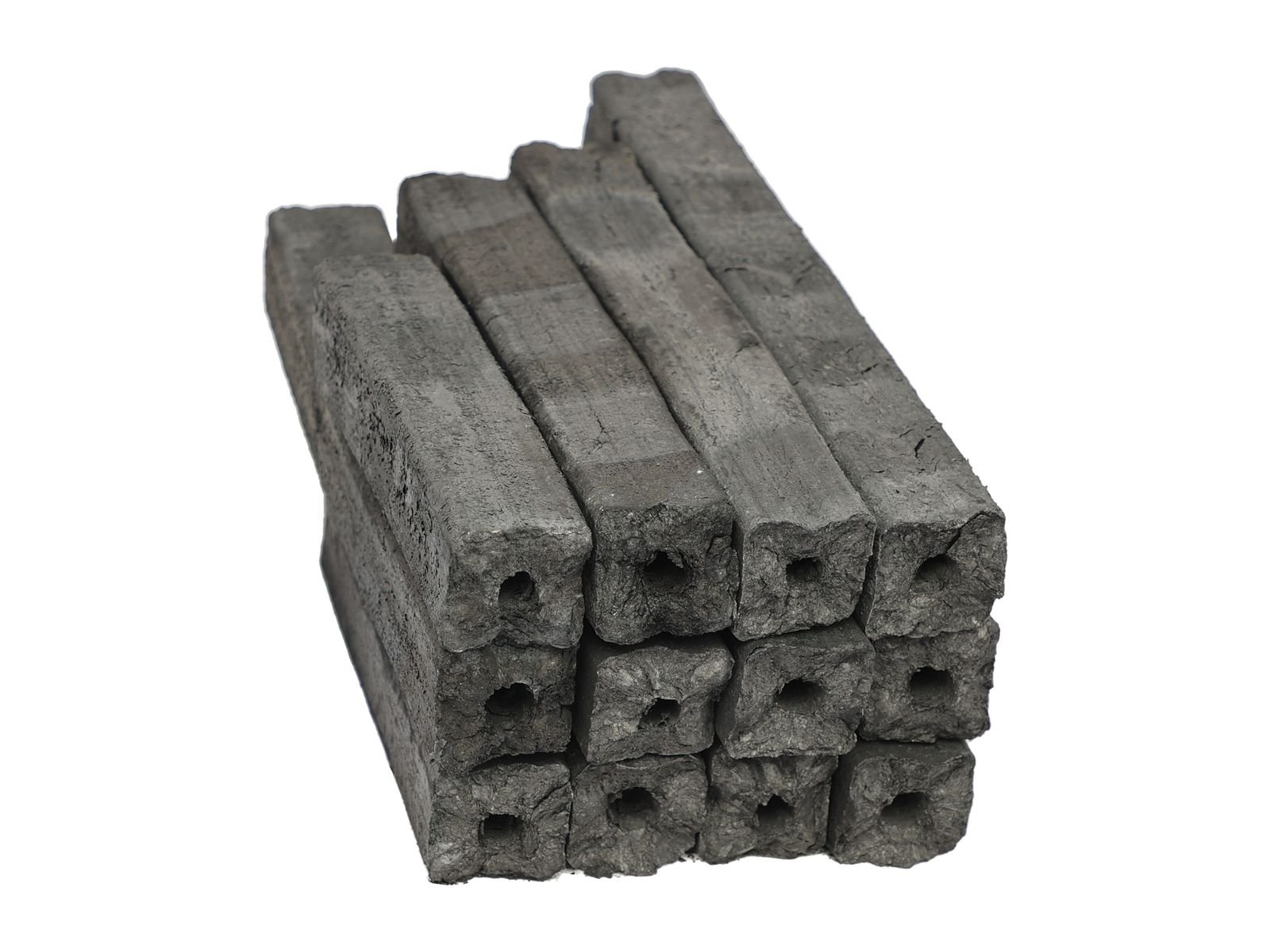
Buying charcoal wholesale raises the same practical questions again and again, whether you run a restaurant group, a retail brand or an import business. This FAQ gathers the answers buyers ask most - about minimum orders, pricing, grades, samples, compliance and shipping - so you can move from curiosity to a confident order. Each answer reflects how a specialist exporter actually works, not generic marketplace advice.
Key takeaways
- Charcoal is bought by the container: binchotan around 9.6 MT net per 20ft, ogatan around 15-16 MT.
- Wholesale prices are quoted, not listed, because grade, packaging, Incoterms and freight all move them.
- Always order against a written spec, a sample and an independent per-lot COA.
- Budget for compliance: a COA, a phytosanitary certificate and, for the EU, EUDR due-diligence.
- Reputable hardwood suppliers never substitute coconut-shell or bamboo charcoal for binchotan.
Buying Charcoal Wholesale: Minimum Orders and Quantities
The first questions about buying charcoal wholesale are almost always about quantity: how much must I buy, and how much fits in a container? Because charcoal is dense and ships by sea, the natural unit is the shipping container rather than the pallet.
What is the minimum order?
The practical minimum is usually one 20ft container. Within that, you can often mix grades if you agree the split in advance with your supplier.
How much charcoal fits in a container?
- Binchotan: typically around 9.6 MT net per 20ft, about 960 cartons of 10 kg.
- Ogatan hexagon: around 15 MT per 20ft.
- Ogatan square: around 16 MT per 20ft.
Treat these as planning figures and confirm the exact loadout with your supplier, since packaging and density change the final weight.
Why the container, and not smaller quantities? Charcoal is bulky and low in value relative to its shipping footprint, so splitting it into parcel-sized lots makes the freight per kilogram uneconomic. Full-container shipping is what keeps wholesale pricing attractive in the first place, which is why almost every serious exporter sets the minimum at one container.
How Wholesale Charcoal Pricing Works
The second cluster of questions is about money: what does it cost, and why will no one publish a fixed number? Wholesale charcoal is quoted rather than listed because several variables move the real price.
- Species and grade: dense, named hardwoods and long, uniform pieces cost more than mixed offcuts.
- Carbonization and moisture: true high-temperature firing and low moisture cost more to produce but ship more usable heat.
- Packaging: printed, retail-ready cartons cost more than plain bulk packing.
- Incoterms and freight: FOB, CIF and DDP shift cost and risk, and ocean freight and currency change week to week.
Volume and continuity matter too: a steady, planned reorder programme is usually easier to price keenly than a one-off spot purchase, because it lets a producer plan production and packaging around you.
Is a cheaper quote always a better deal?
Rarely. A price well below the market usually signals high moisture (you pay to ship water), heavy breakage, fillers, or outright species substitution. The only fair comparison is like-for-like: the same species, size range, moisture and packaging on the same Incoterm, checked against a sample and a per-lot COA.
That is why a specialist exporter asks for your grade, packaging and destination before quoting. For the full picture of grades and container economics, see our binchotan charcoal wholesale guide, then request a quote for your exact shipment.
Need this grade by the container?
Tell us your market, volume and target spec — we reply within one business day with a quote and a sample offer.
Grades, Species and Product Types
Buyers new to the category often ask what they are actually choosing between. VUTRUX focuses on hardwood and fruitwood charcoal in three families.
- Binchotan (white charcoal): fired from dense woods such as eucalyptus, lychee, longan and orange-pomelo, in Grade A and B, round or split, roughly 80-200 mm, packed in 10 kg cartons.
- Ogatan: machine-made sawdust charcoal in hexagon (hollow core) and square (solid) profiles, prized for a long, even burn.
- Hardwood lump: a fast-lighting natural option.
Do you sell coconut or bamboo charcoal?
No. VUTRUX does not sell coconut-shell or bamboo charcoal and never relabels one material as another - a point worth confirming with any supplier. To see where machine-made briquettes fit, read our ogatan charcoal briquettes wholesale guide.
Which grade should I choose?
Match the grade to the end use. Binchotan suits premium grill restaurants and hero retail lines that reward long, clean, low-smoke heat; ogatan briquettes suit high-volume kitchens and value retail packs that need a predictable shape and burn time; hardwood lump suits consumer barbecue ranges that value fast lighting and a natural story. Tell your exporter the end use and let them recommend.
Quality, Samples and the COA
Quality questions come down to two things: can I try it first, and can I trust the numbers? For a serious exporter, the answer to both is yes.
Can I get a sample before ordering?
You should insist on it. Approve a physical sample against a written specification, then keep a retained portion as your benchmark for future lots. VUTRUX works sample-first for exactly this reason.
What should the lab report show?
Each lot should carry an independent Certificate of Analysis. Representative figures are fixed carbon typically around 95% for binchotan and 94% for ogatan, ash and moisture each around 3%, sulphur close to zero, and calorific value around 8,300 kcal/kg. Treat these as ranges, not fixed promises. Our guide on how to read a charcoal COA explains what each line means.
What if a shipment does not match the sample?
This is exactly why you retain part of the approved sample and hold a per-lot COA. If a container drifts from the agreed spec, you have an objective reference for the conversation rather than a difference of memory. Agree up front, in the contract, what happens if goods arrive off-spec, so any remedy is already defined.
Compliance and Shipping Questions
The last set of questions is about getting the goods across a border safely and legally. Charcoal is a wood product, so plan for it from the outset.
What documents do I need?
Expect a per-lot COA, a phytosanitary certificate, EUDR due-diligence for EU-bound cargo, an MSDS, a Certificate of Origin and a Bill of Lading.
Is charcoal dangerous goods for shipping?
Independent self-heating tests conclude the charcoal is not IMDG Class 4.2, although a carrier may still choose to book it under UN 1361. Your exporter should provide the test evidence either way.
What payment terms are normal?
T/T (telegraphic transfer), commonly a deposit with the balance against shipping documents, and L/C (letter of credit) are both standard. An L/C can add security on a first or larger order. Whatever the method, confirm what the deposit secures and what the balance is tied to before you commit.
Can you ship to my country?
Very likely. VUTRUX already serves more than 40 export markets from Hai Phong, so the export mechanics - documents, booking and Incoterms - are routine rather than experimental for most destinations. Share your port and market and we will confirm the specifics with your quote.
Which Incoterms are available?
FOB, CIF and DDP, paid by T/T or L/C. VUTRUX ships FOB Hai Phong to more than 40 export markets. When your questions are answered and you are ready to price a container, request a quote and a sample.
Frequently asked questions
How long does wholesale charcoal take to arrive?
Plan for weeks, not days. Lead time covers production, container stuffing and ocean freight from Vietnam, plus customs clearance on arrival. Preparing your compliance documents in advance is the best way to avoid delays and demurrage at the destination port.
Can I order private-label or custom packaging wholesale?
Often yes. Wholesale orders can use printed, retail-ready cartons or plain bulk packing, which is one of the factors that affects price. Confirm artwork, carton size and case marking with your exporter when you request a quote.
How do I compare two wholesale charcoal quotes fairly?
Compare like for like: the same species and grade, the same moisture and size range, the same packaging and the same Incoterm. A low headline price often hides high moisture, breakage or substitution, so always check the per-lot COA and a sample alongside the number.
Is buying charcoal wholesale worth it for a small restaurant?
If you burn charcoal every service, wholesale usually pays off quickly versus retail bags, even after storage. If your usage is low or seasonal, retail may still suit you. Size your monthly consumption first, then price a container to compare.