For a distributor or importer, VUTRUX charcoal quality is not a slogan - it is a documented, repeatable process that runs from the forest to a certificate matched to the container on your quay. Anyone can call their charcoal premium; what matters is whether a supplier can prove it, lot after lot, with independent testing and paperwork that clears customs. This article explains how VUTRUX controls charcoal quality at every stage, and exactly how you can verify it yourself before you commit to an order.
Key takeaways
- VUTRUX charcoal quality rests on four pillars: controlled sourcing, single-species production, independent per-lot testing and complete export documentation.
- Every lot is tested by an independent laboratory, Vinacontrol; binchotan typically shows around 95% fixed carbon and ogatan around 94%, with ash and moisture near 3%.
- A sample is offered before any order, so the charcoal you approve matches the charcoal you receive.
- Each shipment carries a full compliance pack: per-lot COA, MSDS, EUDR due-diligence data and phytosanitary paperwork.
- You can verify quality yourself by requesting a sample and the per-lot COA, then running your own burn test before you order.
What 'quality' has to mean for a serious buyer
For a home cook, charcoal quality is mostly a matter of taste and convenience. For a business buying by the container, it has to mean something stricter: measurable, repeatable and documented. A single good delivery is not quality; consistency you can rely on, and prove to your own customers, is.
That is the standard behind VUTRUX charcoal quality, and it rests on four pillars that this article works through in turn:
- Controlled sourcing of the right raw material.
- Single-species, consistent production of each product line.
- Independent, per-lot laboratory testing.
- Complete export documentation for every shipment.
Miss any one of these and the others lose much of their value. A beautiful certificate means little if the next lot is a different wood; flawless production means little if you cannot prove it on paper at the port. Quality is the whole chain, held together and repeated on every order, not a single lucky batch you can show a customer once. For a buyer, that distinction is the difference between a supplier you have to re-test with every shipment and one you can standardize on for years.
It starts with the raw material
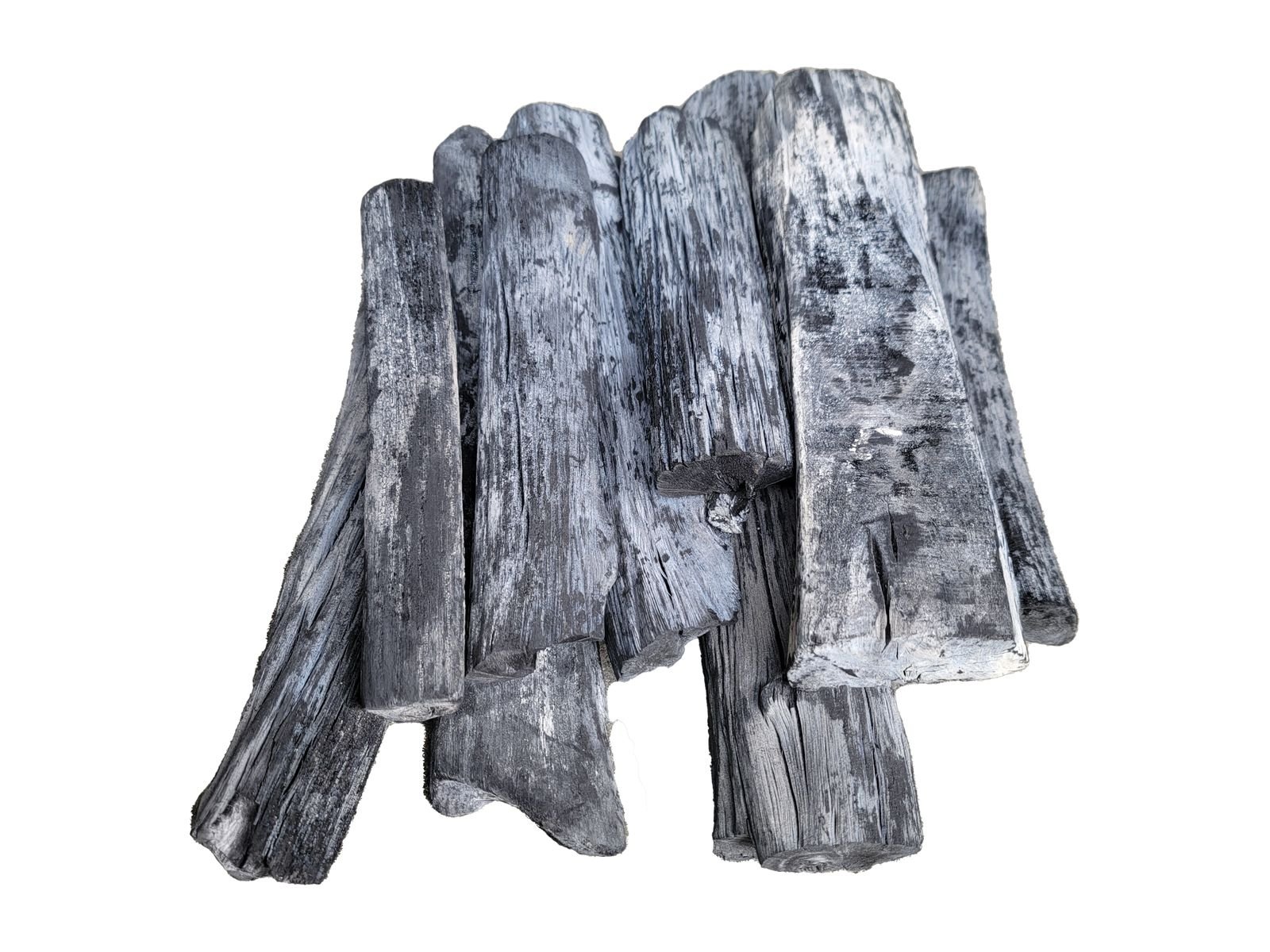
Quality that you can taste and measure starts with what goes into the kiln. VUTRUX controls the raw material by working with specific, named wood species rather than an anonymous 'hardwood' mix. Binchotan is made from dense fruitwoods and hardwoods - eucalyptus (bach dan), lychee and longan (vai and nhan), and orange-pomelo 'mai tieu' (cam buoi) - each chosen for its tight grain, high density and clean, low-resin burn.
The other product lines follow the same discipline. Ogatan is a machine-made sawdust charcoal produced in consistent hexagon (hollow-core) and square (solid) profiles, which gives a highly uniform, low-smoke fuel. Hardwood lump rounds out the range for buyers who want a more rustic, live-fire character. Sourcing named species from known supply also underpins traceability, which is now a legal requirement for anyone importing into the European Union. It is worth being clear about scope, too: VUTRUX does not deal in coconut-shell or bamboo charcoal, so the focus stays squarely on dense wood binchotan, ogatan and hardwood lump, and on doing those few things consistently well. Keeping the range narrow is itself a quality decision: it lets every stage, from the kiln to the grading line, be tuned to a small set of well-understood woods rather than spread thin across everything.
Need this grade by the container?
Tell us your market, volume and target spec — we reply within one business day with a quote and a sample offer.
VUTRUX charcoal quality: independent per-lot testing
The core of how VUTRUX ensures charcoal quality is independent, per-lot laboratory testing. Every production lot is analyzed by an independent laboratory, Vinacontrol, rather than relying on a single flattering certificate reused across many shipments. Because charcoal is a natural product that varies between runs, seasons and species, per-lot testing is the only honest way to know what is actually inside a given container.
On that independent testing, VUTRUX charcoal typically reports the ranges below. These are indicative results, quoted as ranges rather than fabricated exact figures, and each lot carries its own certificate tied to that batch.
| Property | Binchotan (typical) | Ogatan (typical) |
|---|---|---|
| Fixed carbon | Around 95% | Around 94% |
| Ash | Around 3% | Around 3% |
| Moisture | Around 3% | Around 3% |
| Sulphur | Near 0% | Near 0% |
| Calorific value | Around 8,300 kcal/kg | Around 8,300 kcal/kg |
To make sense of these figures on any supplier's certificate, including what to check and what should raise a red flag, see our guide on how to read a charcoal COA. Matching the certificate to a physical sample is the single best protection a buyer has.
The paperwork that protects your shipment
Test results are only useful if they travel with the goods, alongside the other documents an importer needs to clear customs and satisfy regulators. Every VUTRUX shipment is prepared with a full compliance pack:
- Per-lot Certificate of Analysis (COA) from Vinacontrol, tied to the specific lot you are buying.
- Material Safety Data Sheet (MSDS) for safe handling, storage and transport.
- EUDR due-diligence information, including the traceability and geolocation data required by the EU Deforestation Regulation.
- Phytosanitary documentation where the destination market requires it.
On transport classification, independent Vinacontrol self-heating tests conclude that the charcoal is not IMDG Class 4.2, although some carriers may still choose to book it under UN 1361. Having the test results on hand makes those conversations with forwarders far smoother and helps avoid unnecessary delays or surcharges. For an importer, a complete and correct document pack is not paperwork for its own sake; it is what keeps a container moving and a customs broker satisfied. Because deforestation rules now carry real legal weight for European buyers, we cover them in depth in our guide to EUDR compliance for charcoal imports.
Consistency in grading, packing and loading
Quality also has to survive grading, packing and the journey to your warehouse, so it is built into those steps too. Binchotan is sorted into Grade A and Grade B, offered round or split, in sizes from roughly 80 to 200 mm to suit different grills and dishes, and packed in standard 10 kg cartons for easy handling and accurate stock control.
Loading is planned to protect both the product and your landed cost. As a rough guide, a 20ft container holds around 9.6 metric tons net of binchotan (about 960 cartons of 10 kg), while ogatan loads at roughly 15 tons for hexagon and 16 tons for square per 20ft. VUTRUX ships FOB Hai Phong and can also quote CIF or DDP, with payment by T/T or L/C, to more than 40 export markets. Consistent grading and packing mean the pallets you receive match the sample you approved and the certificate on file. Small details like uniform carton weights and clearly marked grades also make receiving, counting and re-selling far easier at your end. For a full walk-through of order sizes, packing and Incoterms, see our binchotan wholesale guide.
How to verify VUTRUX quality yourself
You do not have to take any of this on trust; the entire point of documented quality is that you can check it independently. Before a large order, run this simple verification routine:
- Request a sample. VUTRUX offers a sample before any order, so the coal you approve is the coal you receive.
- Read the per-lot COA and confirm the fixed carbon, ash, moisture and sulphur figures match the product and the lot number.
- Run your own burn test. Time how long the coals hold cooking heat, watch for smoke and sparks, and weigh the ash left behind.
- Check the compliance pack - MSDS, EUDR data and phytosanitary paperwork - against your own destination's requirements.
When the sample, the certificate and your own burn test all agree, you have found a supplier you can build a business on. That alignment between promise and product is the whole aim of VUTRUX charcoal quality. The routine takes little more than an afternoon and a single carton, and it replaces trust with evidence. To start the process, request a quote and a sample and put it to the test yourself.
Frequently asked questions
How does VUTRUX ensure charcoal quality?
Through four linked steps: controlled sourcing of named wood species, consistent single-species production, independent per-lot testing by Vinacontrol, and a full export documentation pack with every shipment. A sample is offered before any order so the coal you approve is the coal you receive.
Does every shipment come with a COA?
Yes. Because charcoal is a natural product that varies between production runs, each lot is tested and carries its own Certificate of Analysis from an independent laboratory. A per-lot COA, rather than one old certificate reused forever, is the only way to know what is actually in your container.
What does VUTRUX charcoal typically test at?
On independent Vinacontrol testing, binchotan typically shows around 95% fixed carbon and ogatan around 94%, with ash and moisture near 3%, sulphur close to zero and calorific value around 8,300 kcal/kg. These are typical ranges; each lot is certified on its own results.
Can I get a sample before ordering?
Yes. VUTRUX offers a sample before any order so you can run your own burn test and check it against the certificate. Sampling first is the best way to confirm that the quality you are promised matches the quality you receive at container scale.
Is VUTRUX charcoal ready for EU import rules?
Yes. Shipments are prepared with EUDR due-diligence and traceability data and phytosanitary documentation where required, alongside the per-lot COA and MSDS. Independent self-heating tests also indicate the charcoal is not IMDG Class 4.2, though carriers may still book it under UN 1361.