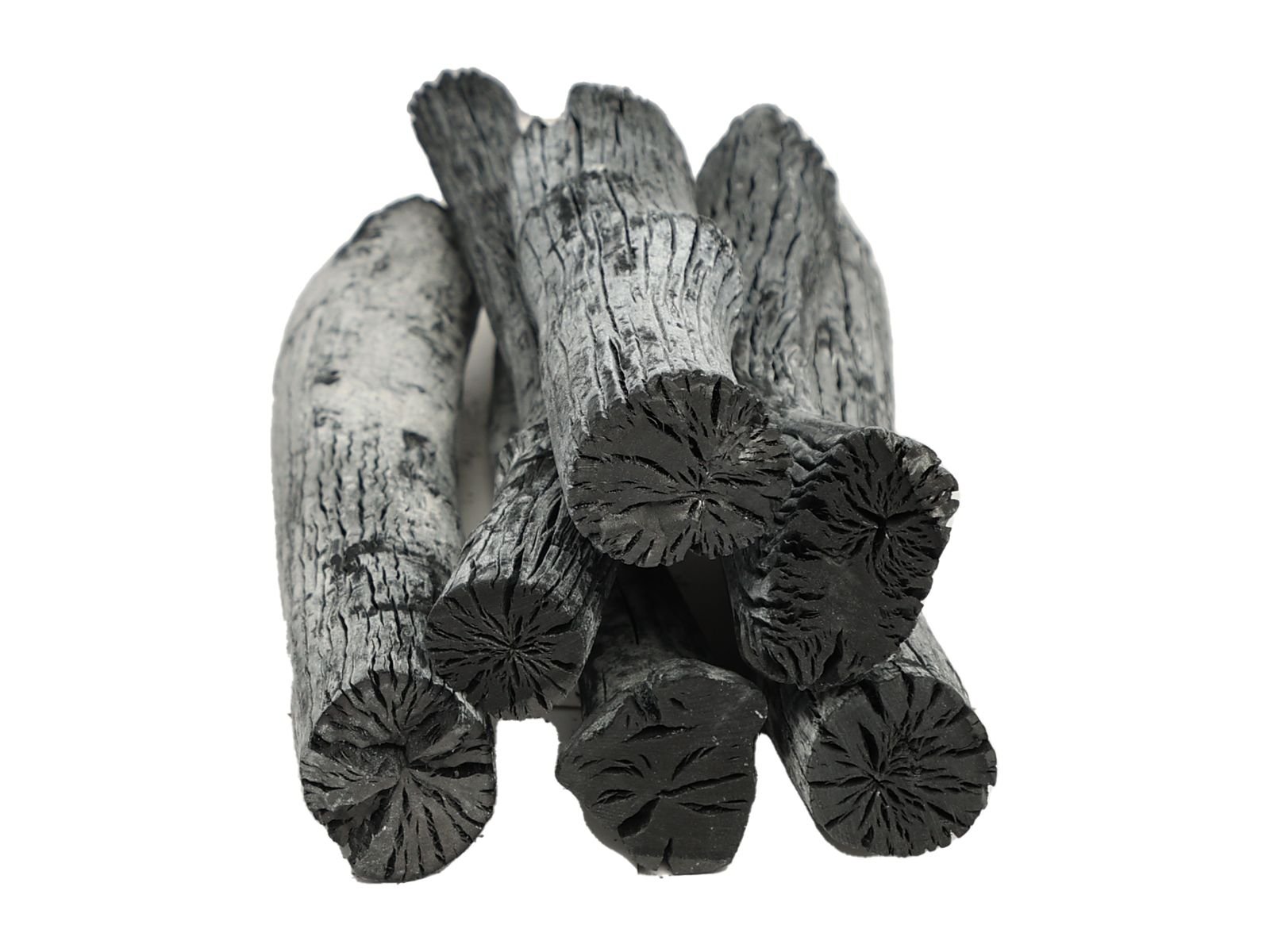
The calorific value of charcoal is the heat energy it releases when it burns, usually quoted in kilocalories per kilogram (kcal/kg) or megajoules per kilogram (MJ/kg). It is the number buyers reach for when they want to compare fuels, but on its own it can mislead. This guide explains what calorific value charcoal figures really mean, what to expect from good hardwood charcoal, what pushes the number up or down, and how it relates to the burn performance you feel at the grill.
Key takeaways
- Calorific value measures the total heat energy stored per kilogram, in kcal/kg or MJ/kg.
- Good hardwood charcoal runs about 7,000 to 8,300 kcal/kg; VUTRUX binchotan and ogatan test near the top of that band.
- High moisture, high ash and high volatile matter all pull calorific value down.
- Calorific value tells you energy content, not burn time or heat intensity, so read it with fixed carbon.
- A bomb-calorimeter figure on a per-lot COA is the only reliable way to compare suppliers.
What calorific value means
The calorific value of a fuel, sometimes called its heating value or energy content, is the quantity of heat released when a fixed mass burns completely. For solid fuels like charcoal it is quoted per kilogram, most often in kilocalories per kilogram (kcal/kg) and sometimes in megajoules per kilogram (MJ/kg). The two convert directly: one kcal is about 4.184 kilojoules, so 8,000 kcal/kg is roughly 33.5 MJ/kg.
You will meet two versions of the figure. Gross calorific value (higher heating value) counts the heat recovered when the water vapor from combustion condenses; net calorific value (lower heating value) does not, so it is a little lower and closer to real-world stove and grill conditions. Lab certificates usually report gross calorific value from a bomb calorimeter. When you compare suppliers, make sure you are comparing the same version, on the same moisture basis.
Why does the unit matter? Because a supplier quoting 34 MJ/kg and one quoting 8,100 kcal/kg may be describing almost identical charcoal, while a third quoting a net value looks weaker on paper for no real reason. Converting every quote to a single unit and basis before you compare is the first discipline of reading energy figures.
What drives the calorific value of charcoal
Charcoal is not a single substance, so its energy content moves with composition. Four factors explain almost all of the variation you will see.
- Fixed carbon is the main heat source. The higher the fixed carbon, the more energy the coal packs, which is why premium hardwood charcoal and binchotan sit near the top of the range.
- Moisture drags the number down twice over: water adds dead weight and steals energy to evaporate. High-moisture charcoal always tests lower per kilogram.
- Ash is non-combustible mineral matter. Every percent of ash is a percent that releases no heat, so high-ash, filler-heavy product has a lower calorific value.
- Volatile matter carries energy too, but a coal that leans on high volatile matter tends to burn fast and smoky rather than long and clean.
In short, the same levers that make a coal test well on a charcoal COA — high fixed carbon with low ash and moisture — are the levers that raise its calorific value.
Need this grade by the container?
Tell us your market, volume and target spec — we reply within one business day with a quote and a sample offer.
Calorific value of charcoal versus other solid fuels
Charcoal earns its place precisely because carbonization concentrates energy. Driving off water and volatile gases leaves a fuel far more energy-dense than the wood it came from, as the comparison below shows. Treat the figures as typical ranges rather than fixed constants.
| Fuel | Typical gross calorific value |
|---|---|
| Air-dried firewood | ~3,500 to 4,500 kcal/kg (roughly 15 to 19 MJ/kg) |
| Hardwood lump charcoal | ~7,000 to 8,000 kcal/kg (roughly 29 to 33 MJ/kg) |
| Binchotan white charcoal | ~8,000 to 8,300 kcal/kg (roughly 33 to 35 MJ/kg) |
| Ogatan sawdust briquette | ~7,500 to 8,300 kcal/kg (roughly 31 to 35 MJ/kg) |
The jump from firewood to charcoal is the whole point of making charcoal: roughly double the heat per kilogram, with far less smoke and a steadier burn.
What to expect from VUTRUX grades
Across VUTRUX product lines the calorific value clusters near the top of the hardwood-charcoal band. On independent-lab (Vinacontrol) testing, binchotan white charcoal typically returns fixed carbon around 95% and a calorific value in the region of 8,300 kcal/kg, with ash and moisture each around 3% and effectively no sulphur. Ogatan, the machine-made sawdust charcoal, tests similarly, with fixed carbon around 94% and calorific value in the same high band.
Two points matter for buyers. First, these are typical figures: charcoal is a natural product and every lot varies, which is why VUTRUX issues a COA per lot rather than reusing one flattering result. Second, a high calorific value only translates into performance when moisture and ash stay low, so read the whole certificate, not one headline number. It is also why the highest advertised figure is not automatically the best buy: a value quoted on a dry basis, or as a gross rather than net figure, can flatter an otherwise ordinary coal.
Calorific value versus burn time and heat
Calorific value is often misread as a measure of how hot or how long a coal will burn. It is neither. It measures the total energy stored in a kilogram of fuel; how fast that energy is released is a separate question decided mainly by density and airflow.
- Heat intensity depends on how quickly the fuel burns, which you control with airflow and coal spacing, not on calorific value alone.
- Burn time depends on density and fixed carbon: a dense binchotan releases its energy slowly, so it burns long and steady, while a light, porous coal of similar calorific value burns out faster.
This is why calorific value should be read alongside fixed carbon and density, not in isolation. Our guide to binchotan versus lump versus briquettes shows how two fuels with similar energy content can feel completely different in service.
A simple way to picture it: two coals can hold the same total energy, but the dense one doles it out slowly, like a log settling on a fire, while the light one spends it in a quick, bright rush. Buyers who chase only the highest calorific number sometimes end up with a coal that burns hot and brief when the kitchen needed long and steady, or the exact reverse.
How calorific value is measured and verified
Calorific value is determined in a bomb calorimeter: a weighed sample is burned in a sealed vessel surrounded by water, and the temperature rise of the water reveals the energy released, typically under a standard such as ISO 1928. It is a separate test from the proximate analysis that gives fixed carbon, ash, moisture and volatile matter.
As with every spec, two things make the figure trustworthy: an accredited, named laboratory and a result tied to the actual lot you are buying, on a stated basis (as-received or dry). A single old certificate reused across many shipments tells you little about the coal on your pallet.
A calorific-value line you can rely on shows several things at once:
- a named, accredited laboratory and a cited method such as ISO 1928;
- a lot or batch number and a date that tie the result to your shipment;
- a stated basis, as-received or dry, so the figure is genuinely comparable;
- a value that sits within realistic ranges for the species and grade.
A calorific value you cannot tie to your lot, tested by a named lab, is a claim rather than a specification.
To compare a real, lot-specific energy figure against your requirement, request a quote and a sample and check the calorific value on the accompanying COA.
Frequently asked questions
What is the calorific value of good charcoal?
Quality hardwood charcoal typically falls between about 7,000 and 8,300 kcal/kg (roughly 29 to 35 MJ/kg). Binchotan and premium ogatan sit near the top of that band. VUTRUX lots commonly test around 8,300 kcal/kg on independent-lab analysis, though every natural lot varies.
How is calorific value different from fixed carbon?
Calorific value measures the total heat energy stored per kilogram, while fixed carbon measures the share of solid combustible carbon. They move together, but calorific value tells you how much energy is present and fixed carbon helps explain how long and steadily it is released. Read the two together.
Does a higher calorific value mean a hotter fire?
Not directly. Calorific value is total energy, not the rate it is released. How hot the fire feels depends mainly on airflow and how the coals are arranged, and how long it lasts depends on density and fixed carbon. A high-calorific, dense binchotan burns long and steady rather than simply hot.
How is calorific value measured?
In a bomb calorimeter: a weighed sample is burned in a sealed vessel surrounded by water, and the temperature rise reveals the energy released, usually under a standard such as ISO 1928. It is a separate test from the proximate analysis that gives fixed carbon, ash, moisture and volatile matter.
How do I convert between kcal/kg and MJ/kg?
One kilocalorie equals about 4.184 kilojoules, so to convert kcal/kg to MJ/kg multiply by 0.004184. For example, 8,300 kcal/kg is about 34.7 MJ/kg. Suppliers may quote either unit, so convert to a common one before you compare figures.